Vibe coding & product design: accelerating without losing the Gesture

Olivier Chatel
Managing Director & Designer
"Look, I did your job in 10 minutes and 2 prompts!". Truths and illusions about the contribution of "vibe coding" tools in our daily lives as product designers.
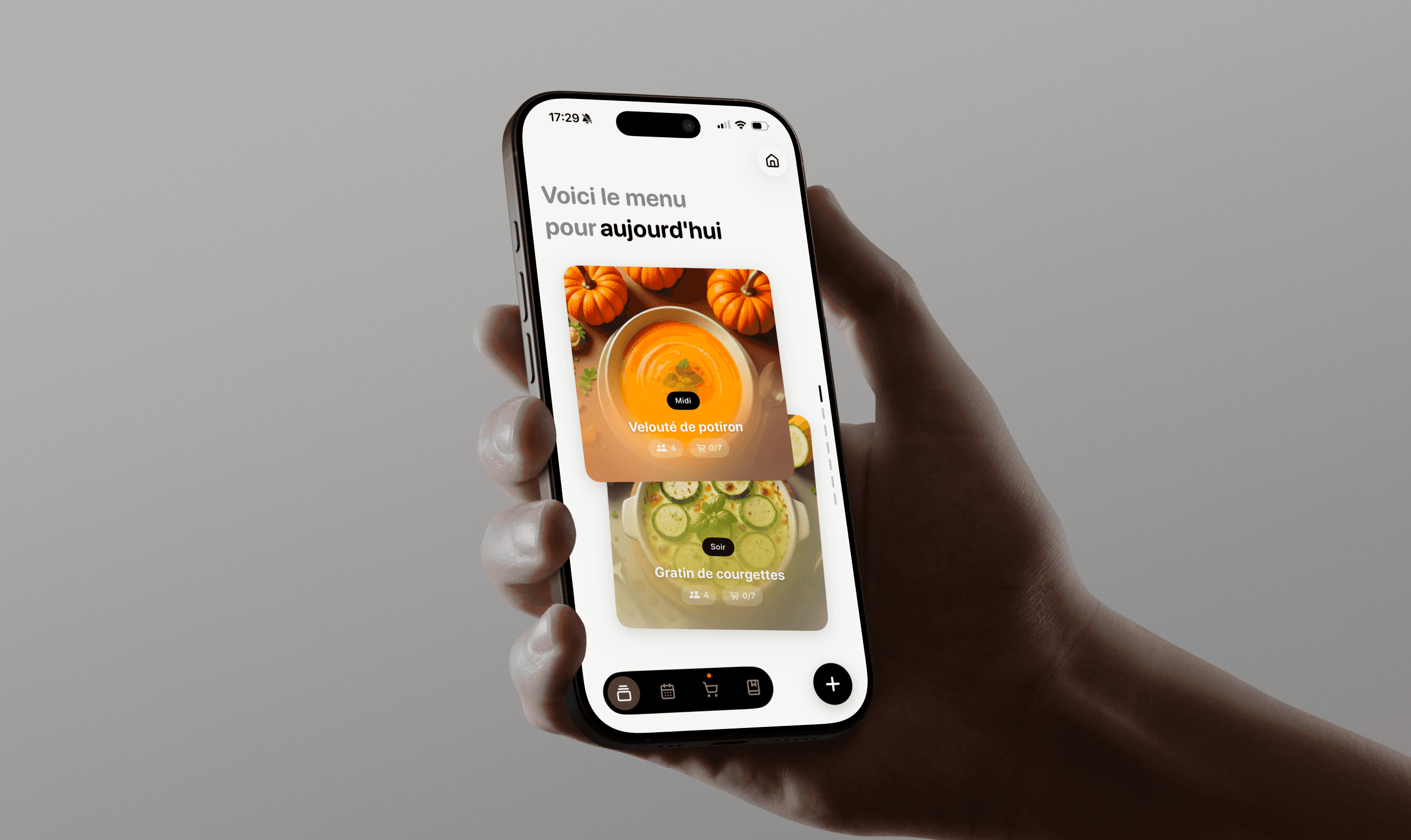
A new generation of tools (Lovable, V0, Cursor, Claude Code…) gives everyone the ability to generate interactive and dynamic interfaces in just a few minutes. Several members of the Source team and I have actually managed to build end-to-end functional products with these tools. An achievement that raises questions about our working methods, in a context of generalized acceleration where promises abound, but results remain uneven and often poorly mastered.
Injecting intention into tools designed for speed
In the face of a given problem, it is now possible, thanks to AI, to generate an infinite number of options in record time. As the technology is trained to comply with good UX practices and relies on well-developed UI component libraries, it can sometimes be tempting to settle for it as is. After all, we end up with a functional and streamlined interface that meets the stated need. It's a thrilling sense of power, which rightly leads some to question the value of going beyond these first drafts.
Let’s put things in perspective: The power of AI is speed. What it loses is intention. The Gesture.
However, producing a quality user experience requires a comprehensive vision, shaped by multiple needs: business, marketing, and users. This vision cannot be fully delegated to AI, which is not trained to think outside the box or create custom solutions.
The designer, on the other hand, harmoniously orchestrates constraints to bring forth optimal solutions, often original, in complex organizational and technical contexts.
The digitization of business processes, in particular, often requires juggling intelligently between standard and custom to facilitate the adoption of new tools.
There is therefore an additional challenge in product design assisted by AI, which involves channeling its intentions to achieve more relevant results in real contexts.
Towards a gradual merging of expertise
As the technical dimension of creating digital products fades, it becomes increasingly clear that the long-established boundaries between different design and coding expertise make less and less sense.
Designers can go further without coding, developers can prototype interfaces without resorting to systematic design.
This redistribution of roles should ultimately contribute to a general increase in the quality of the user experience, since without strong technical barriers, all experts remain involved from start to finish and are equally responsible for the final product.
This convergence is also observed at the tool level, which blur the boundaries: Figma Make, Framer Design... As well as in the hybridization of the profiles sought in the market (creation of the AI design engineer role at Source, for example).
However, even if it is crucial to become familiar with the new capabilities of these tools, their full adoption will only happen through a longer process of support for teams and clients.
Our clients do not expect a tool change. They expect a better product, faster, better aligned with their business reality.
Experience feedback in real conditions
During a sprint to define the target vision of a business tool in logistics, we used Lovable to explore complex interactions that are difficult to illustrate in Figma.
Even in an exploratory phase, it was out of the question for us to present generic screens to decision-makers, whose UI would not have conformed to their usual graphic universe.
Our method:
Preparation: creating a Lovable environment aligned with the charter (colors, fonts, components). A true starter kit, accompanied by precise rules to guide the model.
Framing: writing a structured PRD, used as a master prompt to initiate the project in Lovable. This document, derived from classic methodologies, proved to be remarkably effective with AI.
Iterations: back-and-forth between Figma, Lovable, and Cursor to immediately test ideas in the browser.
In three weeks, with two designers and an AI design engineer, we delivered two complementary prototypes:
Lovable to simulate realistic journeys under quasi-real conditions.
Figma to fix the graphic intention.
This tight workflow promotes shared responsibility for UX. The developer no longer intervenes at the end of the chain, but as a co-designer, alongside the designers.
A new standard, to be handled with clarity
Vibe coding redefines the initial phases of product design. It allows for generating interactive prototypes in a few minutes, aligning stakeholders more quickly, and integrating dimensions long overlooked at this stage of the project: micro-interactions, emotions, user comfort…
This is not a gadget, nor a production deliverable. It is a new exploration tool, powerful yet still fragile. The generated code remains generic, and adaptation to varied contexts is limited. UX gains speed, but risks losing intention if it is not guided.
Nevertheless, it is unimaginable to go back. Vibe coding is gradually establishing itself as a standard in the upstream phases, reconciling speed, visualization, and collaboration. It even opens the way to a new era: that of functionality on demand. A world where each request can produce a custom mini-software, within an ecosystem of shifting interfaces and new devices.
In this context, our role remains intact: orchestrate complexity, structure intention, and continue designing smooth, useful, and memorable experiences.
Are you ready to take the plunge with us?
"Look, I did your job in 10 minutes and 2 prompts!". Truths and illusions about the contribution of "vibe coding" tools in our daily lives as product designers.
A new generation of tools (Lovable, V0, Cursor, Claude Code…) gives everyone the ability to generate interactive and dynamic interfaces in just a few minutes. Several members of the Source team and I have actually managed to build end-to-end functional products with these tools. An achievement that raises questions about our working methods, in a context of generalized acceleration where promises abound, but results remain uneven and often poorly mastered.
Injecting intention into tools designed for speed
In the face of a given problem, it is now possible, thanks to AI, to generate an infinite number of options in record time. As the technology is trained to comply with good UX practices and relies on well-developed UI component libraries, it can sometimes be tempting to settle for it as is. After all, we end up with a functional and streamlined interface that meets the stated need. It's a thrilling sense of power, which rightly leads some to question the value of going beyond these first drafts.
Let’s put things in perspective: The power of AI is speed. What it loses is intention. The Gesture.
However, producing a quality user experience requires a comprehensive vision, shaped by multiple needs: business, marketing, and users. This vision cannot be fully delegated to AI, which is not trained to think outside the box or create custom solutions.
The designer, on the other hand, harmoniously orchestrates constraints to bring forth optimal solutions, often original, in complex organizational and technical contexts.
The digitization of business processes, in particular, often requires juggling intelligently between standard and custom to facilitate the adoption of new tools.
There is therefore an additional challenge in product design assisted by AI, which involves channeling its intentions to achieve more relevant results in real contexts.
Towards a gradual merging of expertise
As the technical dimension of creating digital products fades, it becomes increasingly clear that the long-established boundaries between different design and coding expertise make less and less sense.
Designers can go further without coding, developers can prototype interfaces without resorting to systematic design.
This redistribution of roles should ultimately contribute to a general increase in the quality of the user experience, since without strong technical barriers, all experts remain involved from start to finish and are equally responsible for the final product.
This convergence is also observed at the tool level, which blur the boundaries: Figma Make, Framer Design... As well as in the hybridization of the profiles sought in the market (creation of the AI design engineer role at Source, for example).
However, even if it is crucial to become familiar with the new capabilities of these tools, their full adoption will only happen through a longer process of support for teams and clients.
Our clients do not expect a tool change. They expect a better product, faster, better aligned with their business reality.
Experience feedback in real conditions
During a sprint to define the target vision of a business tool in logistics, we used Lovable to explore complex interactions that are difficult to illustrate in Figma.
Even in an exploratory phase, it was out of the question for us to present generic screens to decision-makers, whose UI would not have conformed to their usual graphic universe.
Our method:
Preparation: creating a Lovable environment aligned with the charter (colors, fonts, components). A true starter kit, accompanied by precise rules to guide the model.
Framing: writing a structured PRD, used as a master prompt to initiate the project in Lovable. This document, derived from classic methodologies, proved to be remarkably effective with AI.
Iterations: back-and-forth between Figma, Lovable, and Cursor to immediately test ideas in the browser.
In three weeks, with two designers and an AI design engineer, we delivered two complementary prototypes:
Lovable to simulate realistic journeys under quasi-real conditions.
Figma to fix the graphic intention.
This tight workflow promotes shared responsibility for UX. The developer no longer intervenes at the end of the chain, but as a co-designer, alongside the designers.
A new standard, to be handled with clarity
Vibe coding redefines the initial phases of product design. It allows for generating interactive prototypes in a few minutes, aligning stakeholders more quickly, and integrating dimensions long overlooked at this stage of the project: micro-interactions, emotions, user comfort…
This is not a gadget, nor a production deliverable. It is a new exploration tool, powerful yet still fragile. The generated code remains generic, and adaptation to varied contexts is limited. UX gains speed, but risks losing intention if it is not guided.
Nevertheless, it is unimaginable to go back. Vibe coding is gradually establishing itself as a standard in the upstream phases, reconciling speed, visualization, and collaboration. It even opens the way to a new era: that of functionality on demand. A world where each request can produce a custom mini-software, within an ecosystem of shifting interfaces and new devices.
In this context, our role remains intact: orchestrate complexity, structure intention, and continue designing smooth, useful, and memorable experiences.
Are you ready to take the plunge with us?
Enjoyed this article? You’ll love Open!
Join our newsletter to get the very best of our content every month — insights, client stories and design experiments, straight to your inbox.
Enjoyed this article? You’ll love Open!
Join our newsletter to get the very best of our content every month — insights, client stories and design experiments, straight to your inbox.
Read next